The ASTROD
The ASTROD is Alan's Sparkgap Trent-Rife and Ozone Device. Well, it needed a catchy acronym and that's all I could come up with when Alan first explained to me how to build one. My family and friends now know it by my nickname for it: The Fire Zapper. I typically use this device for acute illness when I don't know what the bug is or when the frequencies being run on a Rife Bare device aren't doing the trick. I often use it at the same time as a Rife Bare.
The ASTROD produces a damp-wave output of a wide spectrum of frequencies from a tube with a spark gap. The benefits to using this type of device as opposed to a BRG is that a frequency need not be known. The downside is that since the signal is not riding on an RF carrier, it may not penetrate the body as well plus the power is spread among a large amount of frequencies with not much in any one. It does, however, produce some RF directly from the large spikes created by the spark gap which are then "concentrated" by the large capacitors and then dumped into the tube when the voltage builds to a high enough level across the gap. It appears to be perfectly safe to hold onto the tube (as long as the electrodes or wires are avoided). See Usage Notes for more information.
The neon transformer that is used for this device produces very high voltage (typical 7500 - 12000 V) so constructing and using this device is only for those who understand and have experience with high voltage devices. One can easily be killed with a 10000V 30ma device.
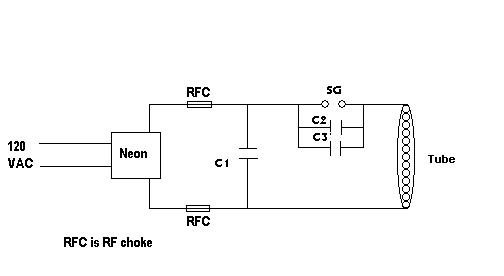
The ASTROD uses homemade capacitors made from wine or champagne bottles. It will operate with a little as one, but using more increases the power output by storing more charge to be output across the gap and then the tube. I currently have three in mine. The diagram below shows how these are connected in the circuit. The Variations article instructs how to make the device using as little as one, two, or more than three capacitors.
The device is mounted in a plastic cooler (Rubbermaid). This keeps down the noise plus contains the ozone produced by the spark, which would quickly become overwhelming in a small room.
After using my first ASTROD a couple of months, the tube began burning oddly. It developed orange plasma areas surrounding the pink beam. I did not think it would burn forever used in an ASTROD since the bubble tubes are not meant to be driven from the electrodes, which causes excessive heat to be generated. At the time I was using the device mostly in radiant, non-contact mode with a large spark gap. I replaced the large bubble tube with a short (20") straight tube from Allred Neon. Note that any tube used must have internal electrodes. I started using short spark gaps on the order of 1/4" or less, mostly in contact mode, and the straight tube has lasted over two years so far.
- Circuit Diagram
- Capacitor Construction
- Circuit Construction
- Variations in capacitor number and placement.
- Spark Gaps describes different types of spark gaps and their use.
- Usage Notes